
Analytical Study of Nanomaterials Under High Pressure
 and Mohit Gupta2
 1Department of Physics, Agra College, Dr. Bhimrao Ambedkar University, Agra, India.
2Department of Chemistry, Institute of Basic Science, Dr. Bhimrao Ambedkar University, Khandari Campus, Agra, India.
Corresponding Author E-mail: rohitguptaagraindia@gmail.com
DOI : http://dx.doi.org/10.13005/msri/190308
Download this article as:

Our previous study we extended an equation of state model for second order bulk modulus from recent predicted model and calculated variation of pressure with volume for several nanomaterials. Now we use such a model for few other nanomaterials like, TiO₂ (anatase), Ni (20 nm), CdSe (rock salt phase), AlN (Hexagonal), 3C-SiC (30 nm) and Rb₃C₆₀., compare with some other equation of state for nanomaterials and experimental data. The Microsoft Office software has been used to do the calculations. The studies gives great agreement with other EOS and experimental data. The study must be useful at high pressure when the experimental data are not available. So the given study must we useful at high pressure.
KEYWORDS:Bulk Modulus; Equation of State; High Pressure; Nanomaterials; Solid
Introduction
Recently the study of nanomaterials are achieving more attention due to its surprising properties such as size, shape, morphology, compressible properties, and their structural properties changed with pressure, volume, and temperature 1, 2. So its extraordinary properties mechanical, thermal and electronic properties make it more relievable for developing several multi functional applications 3. Synthesized and electrochemical anodizations experimental were studied under high pressure up to 31 GPa for Anatase titanium dioxide (TiO2) nanotubes by Raman spectroscopy and synchrotron X-ray diffraction 4 and study of a synchrotron X-ray diffraction presented pressure-induced changes in nanocrystalline anatase (30-40 nm) to 35 GPa 5.
A simple theory predicts for several nanomaterials on the effect of pressure for volume expansion 6 and high-pressure behavior of Ni-filled and Fe-filled MWCNTs examined up to 27 GPa and 19 GPa with help of synchrotron-based angle-dispersive X-ray diffraction 7. A equation of state studied for several namomaterials such as metals Ni (20 nm), α-Fe (nanotubes), Cu (80 nm) and Ag (55nm), semiconductors Ge (49 nm), Si, CdSe (rock-salt phase), MgO (20 nm) and ZnO, and carbon nanotube (CNT) in term pressure related with volume and their theoretical data agreement between experimental data 8. Plasma Enhanced Chemical Vapor Deposition (PECVD) and annealing technique are used in Crystal size synthesized of nanocrystal 3C-SiC (than 30 nm) 9. H.A. Ludwig et al., investigated X-ray experiments under high pressure up to 6 GPa at 300°K for Rb3C60 using a diamond anvil cell and angular dispersive X-ray scattering 10.
Method of analysis
These equations of state (EOS) are determining the effect of pressure on nanomaterials, where P is a function of relative change in Volume

as several equations of states (EOS) written as follows:
Rohit Gupta EOS written as 11,

Mie–Gruneisen EOS written as 12,

Tait EOS written as 13,

Murnaghan EOS written as 14,

Birch–Murnaghan EOS written as 15,

Vinet EOS written as 16,

Kholiya and Chandra EOS written as 17,

Kalita and Mariotto et al. 24 examined experimental data for several nanomaterial compounds but here our interest only few material such as, TiO₂ (anatase), Ni (20 nm), CdSe (rock salt phase), AlN (Hexagonal), 3C-SiC (30 nm) and Rb₃C₆₀. The given experimental data is compared with several other EOSs such as, Rohit Gupta EOS, Mie–Gruneisen EOS, Tait EOS, Murnaghan EOS, Birch–Murnaghan EOS, Vinet EOS and Kholiya-Chandra EOS. Kholiya and Chandra 17 recently performed computational study on high-pressure compression behaviour of nanomaterials and provided good agreement with experimental data at high pressure also verified by average deviations.
Table 1: Shows values of B0, B’0, and B”0 and average percentage deviations from Eq. (1).
|
S. No. |
Nanomaterial |
B0 (GPa) |
B’0 |
B”0 |
Max Pressure (GPa) |
Reference |
|
|
1 |
|
190.4 |
4 |
0.470 |
16.72 |
18 |
|
|
2 |
Ni (20 nm) |
185 |
4 |
0.122 |
33.40 |
19 |
|
|
3 |
CdSe (rock salt phase) |
74 |
4 |
0.360 |
8.00 |
20 |
|
|
4 |
AlN (Hexagonal) |
321 |
4 |
0.481 |
14.5 |
21 |
|
|
5 |
3C-SiC (30 nm) |
245 |
2.9 |
0.128 |
23 |
22 |
|
|
6 |
Rb₃C₆₀ |
17.35 |
3.9 |
0.277 |
0.66 |
23 |
Results and Discussions
Second order bulk modulus (B”0) are calculated for TiO₂ (anatase), Ni (20 nm), CdSe (rock salt phase), AlN (Hexagonal), 3C-SiC (30 nm) and Rb₃C₆₀ nanomaterials and finding pressure for various points with respect to volume for several nanomaterial equation of states like, Rohit Gupta EOS, Mie–Gruneisen EOS, Tait EOS, Murnaghan EOS, Birch–Murnaghan EOS Vinet EOS and Kholiya-Chandra EOS. The data for all nanomaterials defined from three constants such as , and are listed in table 1. The second order bulk modulus are calculated from equation (1). Under compressions of such nanomaterials (TiO₂ (anatase), Ni (20 nm), CdSe (rock salt phase), AlN (Hexagonal), 3C-SiC (30 nm) and Rb₃C₆₀) pressures and its validity test are calculated again from Eq. (1) and several other isothermal EOSs Eq. (2 to 7). Microsoft Office software has been used to do the calculations.
The results obtained from these EOSs are presented in Fig. 1 to 6 in terms between pressure and

and its experimental data from 18-23. Eq. (1) gives better agreement such as compared with the other EOSs. The obtained results compared with experimental data show in Figs. 1 to 6, these values calculated from using Eq. (1) and closer to experimental data of nanomaterials. The experimental uncertainty result provided by Sharma and Kumar [2] with experimental measured P–V data is often pressuring calibration errors; therefore, we considered Eq. (1) calculation for the compression behavior of TiO₂ (anatase), Ni (20 nm), CdSe (rock salt phase), AlN (Hexagonal), 3C-SiC (30 nm) and Rb₃C₆₀. The results are reported in Fig. 1 to 6 along with the experimental data [18-23] and these corresponding results are presented in Table 1. Significantly, the results are showing better agreement with the experimental data.
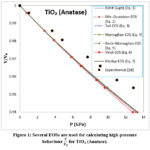 |
Figure 1: Several EOSs are used for calculating high-pressure behaviour for TiO₂ (Anatase). |
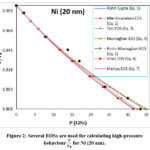 |
Figure 2: Several EOSs are used for calculating high-pressure behaviour for Ni (20 nm). |
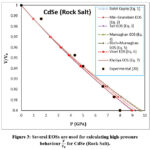 |
Figure 3: Several EOSs are used for calculating high-pressure behaviour for CdSe (Rock Salt). |
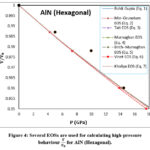 |
Figure 4: Several EOSs are used for calculating high-pressure behaviour for AlN (Hexagonal). |
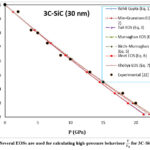 |
Figure 5: Several EOSs are used for calculating high-pressure behaviour for 3C-SiC (30 nm). |
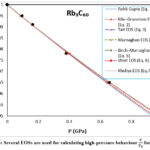 |
Figure 6: Several EOSs are used for calculating high-pressure behaviour for Rb3C60. |
Conclusion
Second order pressure derivative of bulk modulus EOS for nanomaterials are predicted by our previous EOS study. EOSs for nanomaterials are much useful under high pressure compression behavior of nanomaterials and solids. The major advantages of these EOSs are that the experimental data is not available. Therefore the given studies for nanomaterials must be helpful under high-pressure compression behavior because at this level arrangement of experimental setup don’t easy task. The results give better deal compare with experimental data and EOSs data, it is clear from figure 1 to 6. Present work is simple and effective method to study compression behaviour of nanomaterials and solids.
Conflicts of Interest
The authors declare no competing interests.
Funding Sources
There is no funding sources
References
- Ye C, Pan S S, Teng X M and Li G H, J. Appl. Phys. 102, 1 (2007).
CrossRef - Sharma U D and Kumar M, Physica B 405, 2820 (2010).
CrossRef - Kumar R, Sharma U D, Kumar M, Modern Physics Letters B 24, 2647 (2010).
CrossRef - Dong Z, Xiao F, Zhao A, Liu L, Sham T, Song Y, RSC Adv. 6, 76142 (2016).
CrossRef - Swamy V, Dubrovinsky L S, Dubrovinskaia N A, Simionovici A S, Drakopoulos M, Dmitriev V, Weber H P, Solid State Commun. 125, 111 (2003).
CrossRef - Gleiter H 2000 Acta Materialia 48 6243.
CrossRef - Poswal H K, Karmaker S, Tyagi P K, Mishra D S, Busetto E, Sharma S M, Sood A K, Phys. Stat. Sol. (b) 244, 3612 (2007).
CrossRef - Singh M, Tlali S, Narayan H, Nanoscience and Nanotechnology 2, 201 (2012).
CrossRef - Ye C, Ran G, Zhou W, Qu Y, Yan X, Cheng Q, Li N, Nanomaterials 7, 408 (2017).
CrossRef - Ludwig H A, Fietz W H, Hornung F W, Grube K, Renker B, Burkhart G J, Physica C Superconductivity 234, 45 (1994).
CrossRef - Gupta R, Gupta M, Bull. Mater. Sci. 44, 218 (2021).
CrossRef - Born M, Huang K, In Dynamical Theory of Crystals Lattice. Oxford University Press, Oxford (1995).
- Wang Z, Tait K, Zhao Y, Schiferl D, Zha C, Uchida H, Downs R T, J. Phys. Chem. B 108, 11506 (2004).
CrossRef - Anderson O L, In Equation of State for Geophysics and Ceramic Sciences. Oxford University Press, Oxford (1995).
CrossRef - Birch F, J. Geophys. Res. 57, 227 (1952).
CrossRef - Vinet P, Ferrente J, Smith J R, Rose J H, J. Phys C: Solid State Phys. 19, 467 (1986).
CrossRef - Kholiya K and Chandra J, J. Taibah Univ. Sci. 8, 137 (2014).
CrossRef - Swamy V, Dubrovinsky L S, Dubrovinskaia N A, Simionovici A S, Drakopoulos M, Dmitriev V, Weber H P, Solid State Commun. 125, 111 (2003).
CrossRef - Chen B, Penwell D, Kruger M B, Solid State Commun. 115, 191 (2000).
CrossRef - Tolbert S H, Alivisatos A P, J. Chem. Phys. 102, 1 (1995).
CrossRef - Wang Z, Tait K, Zhao Y, Schifer D, J. Phys. Chem. B 108, 11506 (2004).
CrossRef - Liu H, Jin C, Chen J, Hu J, J. Am. Ceram. Soc. 87, 2291 (2004).
CrossRef - Zhou O, Vaughan G B M, Zhu Q, Fischer J E, Heiner P A, Coustel N, Mc Cauley J P J, Smith A B, Science 255, 833 (1992).
CrossRef - Kalita K E L, Mariotto G, Kalita P E, Ohki Y, Physica B 365, 155 (2005).
CrossRef
 PlumX:
 Views: 229 Views
  PDF Downloads:
1275
PDF Downloads:
1275 Accepted on: 07 Nov 2022
Second Review by: Dr. Chuah Lee Siang
Final Approval by: Dr. S. K. Shakshooki