
Investigation of Solubility Behavior, Data Correlations and Thermodynamic Study of Succinic Acid in Water + Methanol Mixtures at Various Temperatures

Department of Chemistry, Mahatma Gandhi Vidyamandir’s M.S.G. Arts, Science and Commerce College, Malegaon, Nashik, India
Corresponding Author E-mail:nahiresandip@gmail.com
DOI : http://dx.doi.org/10.13005/msri/210304
Download this article as:

By using a gravimetric approach, the solubility of succinic acid in water, methanol, and water + methanol binary solvent was determined at temperatures between 305.15 and 313.15 K in the local atmosphere. The findings of the experiment demonstrated a positive correlation between temperature rise and succinic acid solubility. In order to better correlate and match the experimental results, the thermodynamic models van't Hoff and Apelblat were used. Additionally, the DFT investigation was conducted to look into how solvent-solute interactions affected solubility. In addition, the dissolving process's thermodynamic characteristics were computed, and the findings suggested that it was an entropy-driven, spontaneous, endothermic process.
KEYWORDS:Apelblat equation; Methanol; Solubility; Succinic acid; van't Hoff; water
Introduction
With the chemical formula C4H6O4, succinic acid (SA) is a dicarboxylic acid that is also known as butanedioic acid or amber acid. It is used as a precursor in the synthesis of several fine and bulk compounds, such as vitamins, antibiotics, medications, and biodegradable polymers like polyamides and polybutyrate succinate, as well as food additives, ion chelators, and surfactants1-5. Studies on the solubility of succinic acid in a variety of organic solvents, including isopropanol6, water + methanol and water + ethanol mixtures7, binary mixtures of cyclohexanone, cyclohexanol, and cyclohexane8, binary mixtures of methanol, ethanol, and propanol9, and fumaric acid’s solubility in n-propanol, isopropanol, ethanol, and acetone10, are all reported in the literature. With the use of a gravimetric technique, the solubility of succinic acid in water, methanol, and water + methanol binary solvent was investigated at temperatures between 305.15 and 313.15 K in the local environment. Apelblat and van der Hoff equations are two examples of thermodynamic models with which obtained experimental solubilities have been related. Furthermore, the van der Hoff equation has been used to evaluate the energies of solution in order to obtain a better understanding of the phenomena of the succinic acid dissolving process.
Materials and Methods
Triple-distilled water was employed in these studies. MERCK provided 99.5% pure succinic acid, whereas Jiangyin Huaxi International Trade Co. (China) provided 99.9% pure methanol. The equipment and procedures utilized to determine solubility have previously been thoroughly discussed11–13.
In this experiment, a specifically built 100 mL double jacketed flask was used to generate binary solvent mixtures by weight (Shimadzu, Auxzzo) with an uncertainty of ± 0.1 mg. An excess of succinic acid was added to the mixes. Water was pumped between the flask’s inner and outer sides at a steady temperature.
A thermostat was used to regulate the water’s temperature, keeping it within (±0.1) K. In order to ensure equilibrium, the solution was constantly stirred with a magnetic stirrer for a duration of about one hour. Following this, the solution was allowed to stand for one hour. The supernatant liquid was then taken out of the flask and placed in a weighing container in a predetermined quantity using a pipette that is hotter than the solution. This sample was weighed, and it was then maintained at 343 K in an oven until all of the solvent had evaporated. Weighing twice or three times to get a consistent weight allowed us to confirm this.
Weight of solution and solute have been used to calculate solubility. Every solubility value measured is the mean of at least three experiments.
Using standard Eqs. 1 and 2, the saturated mole fraction solubility (Xb), starting methanol mole fraction (XC0), and initial water mole fraction (XA0) were determined.
Xb = (mb / Mb) / (mb / Mb + mA / MA + mC / MC) (1)
XC0= (mC / MC) / (mA / MA + mC / MC) and XA0= (mA / MA) / (mA / MA + mC / MC) (2)
In this case, the molecular weights of the solute, water, and methanol are represented by the letters Mb, MA, and MC respectively, while the masses of the solute, water, and methanol are denoted by the letters mb, mA, and mC.
Results and Discussion
Table 1 lists the solubility values (Xb) of SA in pure water and methanol between 305.15 and 313.15 K, and Figure 1 illustrates how these values change with temperature. It has been noted that temperature has a direct correlation with SA’s solubility in pure solvents. In water + methanol solvent mixes at T = 305.15 to 313.15 K, Table 2 displays the mole fraction solubilities of SA along with the solubilities that were estimated using corresponding models. Figures 2 and 3, respectively, illustrate the solubility of SA in binary solvent mixtures as a function of temperature and the initial mole fraction of solvent.
Table 1: Experimental of mole fraction solubility (Xb) of SA in pure water & methanol at T= (305.15 -313.15 K).
|
T/K |
Xb |
|
|
Water |
Methanol |
|
|
305.15 |
0.0164 |
0.0628 |
|
308.15 |
0.0184 |
0.0665 |
|
310.15 |
0.0203 |
0.0716 |
|
313.15 |
0.0227 |
0.0730 |
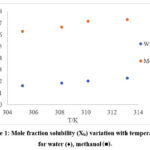 |
Figure 1: Mole fraction solubility (Xb) variation with temperatures for water (♦), methanol (■). |
It is evident that when temperature rises, SA becomes more soluble in all binary solvent mixes. Additionally, when the initial mole fraction of methanol increases, so does SA’s solubility in the water + methanol mixture.
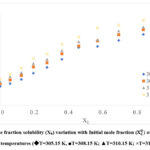 |
Figure 2: Mole fraction solubility (Xb) variation with Initial mole fraction ( of methanol, at various temperatures (◆T=305.15 K, ■T=308.15 K; ▲T=310.15 K; ×T=313.15 K) |
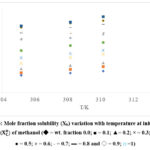 |
Figure 3: Mole fraction solubility (Xb) variation with temperature at initial mole fraction ( of methanol (◆ = wt. fraction 0.0; ■ = 0.1; ▲= 0.2; × = 0.3; × = 0.4; ● = 0.5; + = 0.6; – = 0.7; ▬ = 0.8 and ◇ = 0.9; □ =1). |
Apelblat14-15 and the van’t Hoff model16 are used to link the observed Xb values of SA with temperature. Table 2 provide the computed values of SA in binary solvents for XbApel and Xbvan’t. It is discovered that there is relatively little variation between the calculated and experimental solubilities of these three models. In terms of correlation coefficient (R2) values, the Xb values of SA are correlated with the XbApel and Xbvan’t values of SA in all binary solvents.
Table 2: Experimental (Xb) and calculated mole fraction solubility of SA in various initial mole fraction XC0 of methanol at T= 305.15 to 313.15 K
|
T/K |
XC0 | XbExpt | XbApel | Xbvan’t |
T/K |
XbExpt | XbApel | Xbvan’t |
|
305.15 |
0.0000 |
0.0164 |
0.0164 |
0.0164 |
310.15 |
0.0203 |
0.0203 |
0.0201 |
|
0.0588 |
0.0188 |
0.0188 |
0.0190 |
0.0247 |
0.0245 |
0.0240 |
||
|
0.1232 |
0.0225 |
0.0225 |
0.0225 |
0.0282 |
0.0282 |
0.0282 |
||
|
0.1942 |
0.0278 |
0.0278 |
0.0283 |
0.0361 |
0.0363 |
0.0358 |
||
|
0.2726 |
0.0328 |
0.0328 |
0.0329 |
0.0399 |
0.0399 |
0.0398 |
||
|
0.3599 |
0.0398 |
0.0398 |
0.0399 |
0.0474 |
0.0476 |
0.0475 |
||
|
0.4575 |
0.0501 |
0.0499 |
0.0494 |
0.0551 |
0.0544 |
0.0550 |
||
|
0.5675 |
0.0510 |
0.0513 |
0.0503 |
0.0566 |
0.0581 |
0.0593 |
||
|
0.6922 |
0.0562 |
0.0562 |
0.0563 |
0.0644 |
0.0644 |
0.0643 |
||
|
0.8350 |
0.0614 |
0.0615 |
0.0612 |
0.0677 |
0.0681 |
0.0684 |
||
|
1.0000 |
0.0628 |
0.0625 |
0.0631 |
0.0716 |
0.0704 |
0.0697 |
||
|
308.15 |
0.0000 |
0.0184 |
0.0184 |
0.0185 |
313.15
|
0.0227 |
0.0227 |
0.0227 |
|
0.0588 |
0.0220 |
0.0221 |
0.0219 |
0.0269 |
0.0270 |
0.0274 |
||
|
0.1232 |
0.0258 |
0.0258 |
0.0258 |
0.0321 |
0.0321 |
0.0321 |
||
|
0.1942 |
0.0332 |
0.0331 |
0.0326 |
0.0405 |
0.0404 |
0.0411 |
||
|
0.2726 |
0.0370 |
0.0370 |
0.0369 |
0.0445 |
0.0445 |
0.0446 |
||
|
0.3599 |
0.0445 |
0.0444 |
0.0443 |
0.0527 |
0.0526 |
0.0527 |
||
|
0.4575 |
0.0515 |
0.0521 |
0.0527 |
0.0590 |
0.0592 |
0.0586 |
||
|
0.5675 |
0.0558 |
0.0544 |
0.0555 |
0.0672 |
0.0667 |
0.0653 |
||
|
0.6922 |
0.0612 |
0.0611 |
0.0610 |
0.0694 |
0.0694 |
0.0695 |
||
|
0.8350 |
0.0655 |
0.0651 |
0.0655 |
0.0736 |
0.0735 |
0.0731 |
||
|
1.0000 |
0.0665 |
0.0676 |
0.0670 |
0.0730 |
0.0733 |
0.0740 |
The correlation coefficient (R2) values are nearly equal to one. Based on the Apelblat Model and van’t Hoff model, the estimated solubility and the measured mole fraction solubility show extremely high agreement in these results. As a result, the solubility data fits the van der Hoff equation and the Apelblat Model extremely well. Table 3 and 4 presents the values of the parameters derived from the van der Hoff equation and the Apelblat model, together with R2. The correlation coefficient data (R2 ≈ 1) show a strong relationship between the experimental mole fraction solubility, the Apelblat Model, and the van der Hoff model.
Table 3: Model parameters and correlation coefficient of the Apelblat equation.
|
Solvent |
XC0 |
Parameters |
R2 |
||
|
A |
B |
C |
|||
|
Methanol |
0.0000 |
-2169.7 |
92508.69 |
325.6688 |
0.9999 |
|
0.0588 |
663.7504 |
-33461.7 |
-97.4497 |
0.9986 |
|
|
0.1232 |
266.753 |
-16044.3 |
-38.1014 |
0.9999 |
|
|
0.1942 |
2587.085 |
-122710 |
-382.557 |
0.9994 |
|
|
0.2726 |
163.0504 |
-10732.8 |
-22.9503 |
0.9999 |
|
|
0.3599 |
116.2437 |
-8315.35 |
-16.1196 |
0.9991 |
|
|
0.4575 |
-1888.83 |
84837.85 |
281.0471 |
0.9791 |
|
|
0.5675 |
-3597.38 |
162342.2 |
535.3105 |
0.9631 |
|
|
0.6922 |
275.6835 |
-14924.4 |
-40.1436 |
0.9999 |
|
|
0.8350 |
-926.877 |
40618.35 |
138.2637 |
0.9964 |
|
|
1.0000 |
1529.997 |
-71975.1 |
-226.699 |
0.9581 |
|
Table 4: Model parameters and correlation coefficient of the Van’t Hoff equation.
|
Solvent |
XC0 |
Parameters |
R2 |
|
|
A |
B |
|||
|
Methanol |
0.0000 |
8.7734 |
-3932.27 |
0.9984 |
|
0.0588 |
10.3223 |
-4358.59 |
0.9856 |
|
|
0.1232 |
10.1882 |
-4266.85 |
0.9998 |
|
|
0.1942 |
11.0468 |
-4459.11 |
0.9874 |
|
|
0.2726 |
8.5093 |
-3638.71 |
0.9999 |
|
|
0.3599 |
7.6989 |
-3332.68 |
0.9991 |
|
|
0.4575 |
3.6632 |
-2035.70 |
0.9492 |
|
|
0.5675 |
7.2535 |
-3125.86 |
0.9185 |
|
|
0.6922 |
5.3673 |
-2515.70 |
0.9995 |
|
|
0.8350 |
4.1533 |
-2119.88 |
0.9894 |
|
|
1.0000 |
3.4659 |
-1900.85 |
0.9361 |
|
The thermodynamic study of solubility of SA is carried out in order to evaluate dissolution pattern of SA in pure as well as binary solvent combinations. Thermodynamic parameters (∆H0soln,∆S0soln, ΔG0soln) of dissolution are calculated for this purpose. Using Eq., the ∆H0soln values at the mean harmonic temperature (Thm) of 309.15 K are calculated using van’t Hoff analysis17,18.
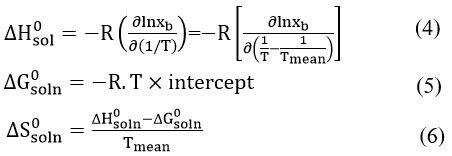
Table 5 displays the values of ΔG0soln, ∆H0soln, and ∆S0soln, for the SA dissolution in water + methanol. The findings indicate that when the initial mole fraction of alcohols increases, the, ∆H0soln values for SA dissolution in all mixes decrease. Every mixture’s SA dissolving process is endothermic, as indicated by the positive ∆H0soln values. In pure water, the value of ∆H0soln is 32.69 kJK-1mol-1, whereas in methanol, it is 15.80 kJK-1mol-1. This shows that dissolving SA in water takes more energy than dissolving it in methanol. The total organic acid solubility and the Gibbs free energy data show a similar trend: the greater the solubility values, the lower the Gibbs free energy.
Table 5: Thermodynamic parameters relative to solution process of SA at Thm= 309.15K
|
XC0 |
∆H0sol KJK-1 mol-1 |
∆G0sol KJK-1 mol-1 |
T∆S0sol KJK-1 mol-1 |
ζH% |
ζTS% |
|
0.0000 |
32.69 |
9.94 |
22.75 |
58.97 |
41.03 |
|
0.0588 |
36.24 |
9.51 |
26.73 |
57.56 |
42.44 |
|
0.1232 |
35.48 |
9.10 |
26.37 |
57.36 |
42.64 |
|
0.1942 |
37.07 |
8.51 |
28.56 |
56.48 |
43.52 |
|
0.2726 |
30.25 |
8.22 |
22.04 |
57.86 |
42.14 |
|
0.3599 |
27.71 |
7.76 |
19.95 |
58.14 |
41.86 |
|
0.4575 |
16.93 |
7.36 |
9.57 |
63.89 |
36.11 |
|
0.5675 |
25.99 |
7.20 |
18.79 |
58.04 |
41.96 |
|
0.6922 |
20.92 |
6.98 |
13.94 |
60.01 |
39.99 |
|
0.8350 |
17.63 |
6.81 |
10.81 |
61.98 |
38.02 |
|
1.0000 |
15.80 |
6.76 |
9.05 |
63.60 |
36.40 |
Conclusion
The mole fraction solubility of succinic acid (SA), a significant industrial chemical, in pure and binary solvent mixtures has been experimentally evaluated within the temperature range of 303.15 to 313.15K. Investigations are done on the impact of temperature and solvent composition. It has been noted that solubility constantly rises with temperature, indicating that all solvent mixes have a positive dissolving enthalpy.
As the initial mole fraction of methanol increases, so does SA’s solubility in the water + methanol combination. Using the Apelblat and van der Hoff models, the experimental solubility values of SA are extremely strongly associated with temperature. Thermodynamic characteristics demonstrate that the SA dissolving process is endothermic.
Acknowledgement
The author is thankful to Principal of MSG Arts, Science and Commerce College Malegaon for providing laboratory facilities. The authors also express their sincere thanks to Dr Apoorva Hiray (Co-ordinator M.G. Vidyamandir Malegaon).
Funding Sources
The author(s) received no financial support for the research, authorship, and/or publication of this article.
Conflict of Interest
The authors do not have any conflict of interest.
Data Availability Statement
This statement does not apply to this article
Ethics Statement
This research did not involve human participants, animal subjects, or any material that requires ethical approval.
Informed Consent Statement
This study did not involve human participants, and therefore, informed consent was not required
Authors’ Contribution
The sole author was responsible for the conceptualization, methodology, data collection, analysis, writing, and final approval of the manuscript
References
- Zeikus J.G., Jain M.K., Elankovan P. Biotechnology of succinic acid production and markets for derived industrial products. Appl. Microbiol Biotechnol. 1999;51:545-552.
CrossRef - Song H., Lee S.Y. Production of succinic acid by bacterial fermentation. Enzyme and Microbioal Technology. 2006;39:352-361.
CrossRef - Willke, T., Vorlop, K.D. Industrial bioconversion of renewable resources as an alternative to conventional chemistry. Appl Microbiol Biotechnol. 2004;66:131–142.
CrossRef - Hong, S.H. Systems approaches to succinic acid-producing microorganisms. Biotechnol. Bioprocess Eng. 2007;12:73–79.
CrossRef - Barros M. d., Freitas S., Padilha G. S., Alegre R. M. Biotechnological Production of Succinic Acid by Actinobacillus Succinogenes Using Different Substrate. Chemical Engineering Transaction. 2013;32:985-990.
- Davey R. J., Mullin J. W., Whiting M. J. L. Habit modification of succinic acid crystals grown from different solvents, J. Cryst. Growth. 1982; 58:304–312.
CrossRef - Jiang X., Hu Y., Meng Z., Yang W., Shen F. Solubility of succinic acid in different aqueous solvent mixtures: Experimental measurement and thermodynamic modeling. Fluid Phase Equilib. 2013;341:7–11.
CrossRef - Sheng X., Luo W., Wang Q. Determination and Correlation for the Solubilities of Succinic Acid in Cyclohexanol + Cyclohexanone + Cyclohexane Solvent Mixtures. J. Chem. Eng. Data. 2018;63:801–811.
CrossRef - Bancroft W.D., Butler F.J.C. Solubility of Succinic Acid in Binary Mixtures. J. Phys. Chem. 1932;36:2515–2520.
CrossRef - Dang L., Du W., Black S., Wei H. Solubility of Fumaric Acid in Propan-2-ol, Ethanol, Acetone, Propan-1-ol, and Water. J. Chem. Eng. Data. 2009;54:3112–3113.
CrossRef - Pawar R. R., Golait S. M., Hasan M., Sawant A. B. Solubility and Density of Potassium Iodide in a Binary Propan-1-ol−Water Solvent Mixture at (298.15, 303.15, 308.15, and 313.15) K. J. Chem. Eng. Data. 2010;55:1314-1316.
CrossRef - Pawar R. R., Aher C. S., Pagar J. D., Nikam S. L., Hasan M. Solubility, Density and Solution Thermodynamics of NaI in Different Pure Solvents and Binary Mixtures. J. Chem. Eng. Data. 2012;57:3563-3572.
CrossRef - Pawar R. R., Nahire S. B. Investigation Correlation and DFT study for solubility of Malonic acid in water + methanol and water + ethanol binary solvents at T = 293.15 to 313.15 K. Research J. Pharm. and Tech. 2021;14(3):1226-1232.
CrossRef - Apelblat A., Manzurola E. J. Solubilities of o-acetylsalicylic, 4-aminosalicylic, 3,5-dinitrosalicylic, and p-toluic acid, and magnesium-DL-aspartate in water from T = (278 to 348) K. Chem. Thermodyn. 1999;31:85-91.
CrossRef - Yang Z. H., Shao D. F., Zhou G. Q. Solubility parameter of lenalidomide for predicting the type of solubility profile and application of thermodynamic model. J. Chem. Thermodyn. 2019;132:268-275.
CrossRef - Prausnitz J.M., Lichtenthaler R.N., Azevedo E.G. Molecular Thermodynamics of Fluid-Phase Equilibria, 3rd ed., Englewood Cliffs, NJ, Prentice- Hall, 1999.
- Yu Y., Zhang F., Gao X. Q., Xu L., Liu G. J. Experiment, correlation and molecular simulation for solubility of 4-methylphthalic anhydride in different organic solvents from T = (278.15 to 318.15) K Mol. Liq. 2019;275:768-777.
CrossRef - Hildebrand J. H., Prausnitz J. M., Scott R. L. Regular and Related Solutions,Van Nostrand – Reinhold, NewYork,1970.
 PlumX:
 Views: 586 Views
  PDF Downloads:
727
PDF Downloads:
727 Accepted on: 07 Nov 2024
Second Review by: Dr. Kavita Singhal
Final Approval by: Dr. K. M. Garadkar