
Densifying Conduction Network in the Skeleton of Non-conducting Natural Feathers for Developing Flexible Conductive Composite
 , Neha Agrawal*and Savita Gaur
 Product Development and Technology Management Division, Defence Institute of Physiology & Allied Sciences (DIPAS-DRDO), Delhi, Delhi, India
Corresponding Author E-mail: *neha.dipas@gov.in
DOI : http://dx.doi.org/10.13005/msri/230108
Download this article as:

Electrical and thermal conducting flexible composite materials are in demand for next-generation electronics. Devices like biomedical instruments, conducting textiles, low-power sources, electronic skin, and flexible displays require stretchable conductors possessing high electrical conductivity under excessive strain and deformation. In this respect, renewable, sustainable materials and/or their biomimicry could help to generate a three-dimensional, highly dense structure. We in this study have hence used the naturally occurring, densified non-conducting feather skeleton to develop three-dimensional conducting films. Herein, the natural feathers were treated with polydopamine solution to create a coating layer with dual action, as a linker for conductive filler as well as for self-adherence of feathers. The optimized amount of feathers and polydopamine is adsorbed with modified carbon nanotubes. Two simple laboratory methods of dip coating and freeze-drying process for the adsorption of conducting material, were optimized. The feathers themselves and polydopamine-coated feathers showed nil electrical conductivity, while different concentrations of filler-containing films showed electrical resistance from 5 to 1 kilo ohm. The film showed similar resistance after bending (50%), stretching (50%), compressing, and even breaking the film and reforming it 10 times exhibited similar trends. The high conductivity, electromechanical stability, and easy production methods make such nano-bio composites as renewable substrates for next-generation electronic devices.
KEYWORDS:Conducting Film; Densified Structures; Modified Carbon Nanotubes; Natural Feathers; Renewable Sources
Introduction
With the fast growth of flexible electronic devices, energy conversion, storage, dissipation and protection from electromagnetic energy need development of novel conductive composite materials.1 The rate of flow of electrons for electric conduction vis a vis of phonon for thermal conduction depends upon the conduction pathway attained three dimensionally in composite networks. Hence the performance of flexible and stretchable conductors depends on two major factor one being the material and other their layout in definite structures.2
Densified networks engineering leading filler alignment is an influential emerging method for creation of continuous conductive pathways.3, 4 The strategy of pre-constructing three-dimensional network followed by functionalization and filler loading has been employed for development of high-performance conductive composites. Such pre-defined networks offer structural controllability of filler and allow high customizability considering conducting attribute. The process of constructing three-dimensional network structure has thus attracted researcher’s interest for achieving higher stability with flexibility. Three dimension (3D) densified network designed through various chemical and physical method has been reported in literature. Likewise, chemically functionalized surface of polyurethane sponge was utilized as 3D skeleton for constructing conductive network through dip coating or electro-less deposition of metal layers.5,6
Continuous arrangement of carbon fiber could enhance contact area by reducing interfacial thermal resistance which could increase thermal conduction of carbon fiber loaded composite.7 It has been reported that secondary networks made by graphene incorporation within carbon fibers array could not only form a more densified seamless interconnects between carbon fiber but additionally introduces thermal conduction paths leading to low thermal contact resistance of 865 K W-1 and hence significantly enhance in plane thermal conduction4. Another study utilized nature inspired 3D assembly structure of wood for fabrication of conductive film with Mxene and hemicellulose networks via simple self-assembly process. Abundant oxygen containing functional groups of hemicellulose allowed embedding of Mxene sheets tethering together adjacent nanosheets through hydrogen bonding forming ‘reinforced concrete’ like structure.8 Inspired by such structures naturally occurring fibers and feathers act as another 3D scaffolds for creating hierarchical arrangement. Bamboo fiber had been used with Ni-Fe-P alloy electroless plating for creating energy conversion composites which could be utilized as solar heater, joule heater and even as electromagnetic shielding.9
In similar fashion another natural feather which holds utmost importance due to its tiered structure are keratin based down fibres.10 Down fibers are well known thermal insulators and attains its richness due to its fluffy nature as well as abundant reserves because of its structure.11 Twinning between down fibres could infact result in 3D network structure which could be well exploited as densely interconnected skeleton for fabrication of flexible conductors. Utilizing such network a study is reported in literature where silver nanowires were arranged on surface of modified down feathers to form binary networks for flexible conductors. The study attained higher conductivity and stability to bending as well as stretchability showing its high-class performance for constructing flexible film like conductors.12 Inspired from such study we here have utilized modified carbon nanotubes as conducting base material and natural feathers as 3D skeleton structure for fabrication of conducting flexible film like structure. Carbon nanotubes (CNTs) hold its own importance being a less expensive, biocompatible, resistant to oxidation and highly conductive nanomaterial. Being one dimension nanomaterial compared to other 2D materials like graphene and Mxene CNTs also allow high thermal conduction through effective phonon conduction pathways.13 Hence, we have tried to form conductive network with natural feathers and non-covalently modified CNTs via dip coating and freeze-drying method. Freeze drying method holds its own uniqueness in providing and conserving the structural integrity which could further enhance the overall property of composites. The key point of study reveals the utilization of non-covalently modified CNTs utilization to form better interaction between modified natural feather skeleton. The two methods are compared in terms of their response to conduction of electrons. Also, electro-mechanical ability of films is monitored after bending, stretching as well as reforming to develop a sustainable flexible form of conductor for future electronics.
Materials and Methods
Materials
Dopamine hydrochloride (Sigma-Aldrich), phosphate (PBS) buffer, lithium hydroxide, 6 amino hexanoic acid, sodium chloride (Sinopharm) and isopropyl alcohol (Sinopharm). High-purity silver paste (SPI), multiwall carbon nanotubes (CNTs).Recyclednatural feather was obtained from used winter clothing & ensembles.
Method
Preparation of poly-dopamine coated natural feathers
The natural feathers were mixed with varied concentration of dopamine in PBS buffer at pH 9 for a period of 24 hours. The process of modification was optimized by varying different time of coating.
Preparation of conductive composite with dip coating method and freeze-drying process
The modified natural feathers were dip coated with different concentration of modified CNTs. The amount and concentration of CNTs were varied in various ratio to feather amount. The modified CNTs were sonicated in isopropanol for 30min. The dispersed solution of CNTs were used to modify the surface of feathers coated with polydopamine by dip coating and drying method until all the volume of solution got soaked and dried.
For freeze drying process the prepared polydopamine coated natural feathers were interacted with modified CNTs solution. The modified CNTs were sonicated in water for 45min. The dispersed solution of CNTs were poured directly to polydopamine coated feathers and freezed at -800C for 2h followed by lyophilization for 48hours at -400C until completely dried.
Results
Structural and Modification of Natural Feathers
Natural feathers have intensive structural aspect which was here utilized as skeleton for constructing conductive composite. The branches and sub-branches of natural feathers could help in forming interconnected networks which in return could act as constructive pathway for conduction. The SEM images of natural feather shown in figure 1 clearly highlights the structural aspect of natural feather. This natural feather skeleton was modified with polydopamine solution. Since dopamine polymerize through free radical reaction to form its polymer polydopamine at a pH of 9 so the solution of dopamine in pH buffer solution was used for modification of natural feather surface. The amount and concentration of dopamine was optimized by visualizing the color of natural feather after modification as it turned from off white to blackish grey due to the deposition of polydopamine layer.
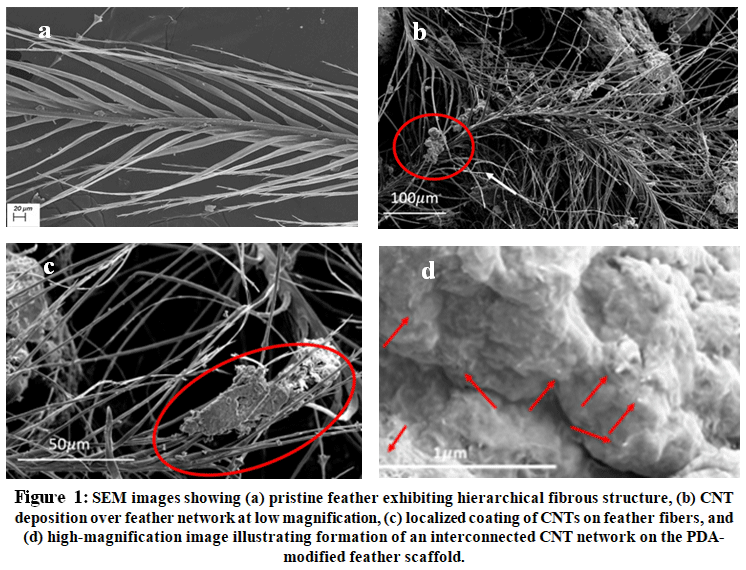 |
Figure 1: SEM images showing (a) pristine feather exhibiting hierarchical fibrous structure, (b) CNT deposition over feather network at low magnification, (c) localized coating of CNTs on feather fibers, |
The successful optimization of polydopamine coated feather was confirmed through FT-IR as
In figure 2. The successful adherence of polydopamine (PDA) onto the natural down fibers is confirmed by the distinct spectral changes in the FTIR analysis. The broadening and increased intensity of the peak at 3265 cm-1 indicate the overlapping of phenolic -OH and amine -NH groups from the PDA layer. Further evidence is found in the intensification of the Amide I (1624 cm-1) and Amide II (1512 cm-1) regions, attributed to the aromatic C=C stretching and indole ring formation during polymerization. Most notably, the enhanced absorption in the 1200–1300 cm-1 range represents the C-O stretching of catechol groups, providing definitive chemical proof of the coating.
The presence of polydopamine was also witnessed in optical microscopy due to presence of rough surface compared to pristine natural feather surface. Further this modified natural feather was compared with raw natural feather in terms of their hydrophobicity. It is known that protein-based keratin natural feather is inherently superhydrophobic in nature while the modified natural feather surface showed a small amount of adsorption of water due to presence of polydopamine layer, however the layer of polydopamine was adjusted such that the hydrophobicity aspect is rationally maintained as shown in photographic image in figure 3 (first two from left).
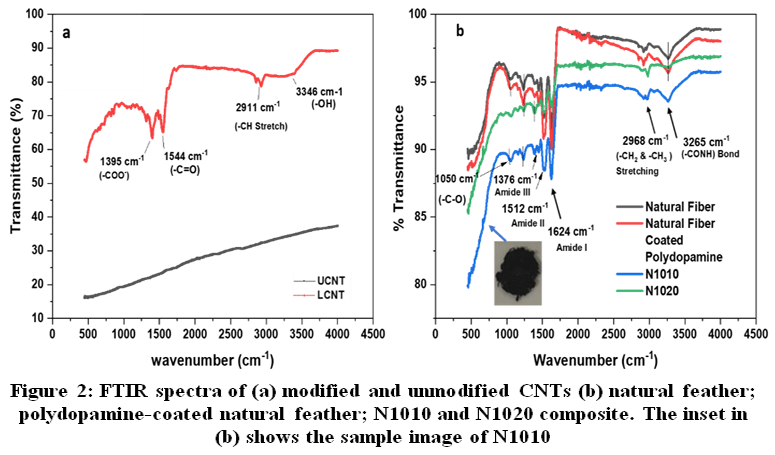 |
Figure 2: FTIR spectra of (a) modified and unmodified CNTs(b) natural feather; polydopamine-coated natural feather; N1010 and N1020 composite. The inset in (b) shows the sample image of N1010 |
Coating of modified natural feather with conducting carbon nanotubes
The interaction of carbon nanotubes requires presence of functional group on its surface. Since the concept of sustainability was base of the work so the modification of CNTs were done in all aqueous solution via a simple noncovalent modifier lithium salt of 6-aminohexanoic acid. The CNTs were modified as described in other works and characterized by FT-IR as shown in figure 2 for the presence of functional group10. The additional advantage of same modifier on CNTs surface holds that an optimized ratio of modifier allows to attain pH 9 on being dispersed. Hence this ability of modified CNTs were additionally useful here as it allows further proper interaction of feather with conducting materials since dopamine polymerize to form polydopamine at pH 9.
Modified CNTs were tried to interact with natural feather surface through two processes. The first being the simple dip coating method where modified CNTs in different concentration and volume was interacted with modified natural feather surface by dipping and drying process. The other method utilized was freeze drying method where the natural feather, polydopamine and CNTs were mixed in aqueous solution, freeze and lyophilized at -40oC for two days. The difference between both process was assessed through water absorption ability of conducting composite designated as N1010 and N1010L for one of the concentrations of dip coated and lyophilized sample respectively. It was observed that lyophilized samples showed higher hydrophobic aspect compared to its dip coated counter sample. Hydrophobicity behavior of the composites was evaluated (Figure S1), showing reduced water absorption in freeze-dried samples compared to dip-coated counterparts.
Conductivity aspect of composite
The CNTs modified composites with different composition was tested for their resistance and hence conductivity aspect. With the change of ratio of amount of natural feathers and CNTs the resistance aspect varied as shown in figure 3. The composites N1010 and N1020 with the compositional ratio of 1:1 and 1:2 w.r.t. feather and CNTs showed better conductivity range compared to other composites. N1020L corresponds to the lyophilized sample of N1020. This optimized ratio of composites was prepared with both dip coating and freeze-drying method. The conductivity of composite could be tuned by varying the concentration of conducting material however after a certain concentration there appears saturation which could be possibly due to improper dispersion of modified CNTs at higher concentration.
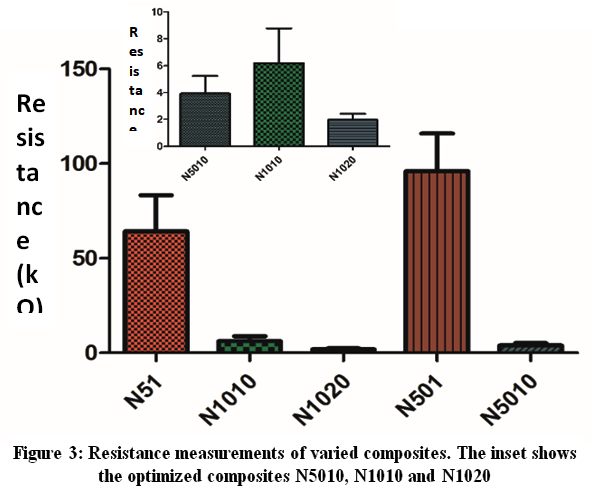 |
Figure 3: Resistance measurements of varied composites. The inset shows the optimized composites N5010, N1010 and N1020 Click here to View Figure |
The optimized composite was further evaluated for their varied voltage to current response. The voltage was varied from 10V to 20V, and the composite was kept at a particular voltage for a period of 30min. The average value at different voltages were plotted for comparing the performance of dip coated and freeze-dried sample as shown in figure 4. It was observed that the freeze-dried sample showed a higher current attainment compared to its dip coated counter partner. This attainment of higher current in case of freeze-dried sample shows that the process method plays important role in maintaining the internal structure of composite. The 3D structure attained through dip coated sample compared to freeze dried sample attains less interconnected network leading to attainment of lower current value.
Freeze-dried composites exhibited improved conductivity and hydrophobicity due to better preservation of the interconnected 3D structure. The composites maintained nearly constant resistance under bending, stretching, and repeated reformation cycles, indicating good electromechanical stability. However, further improvements in conductivity and mechanical performance are required for practical electronic applications.
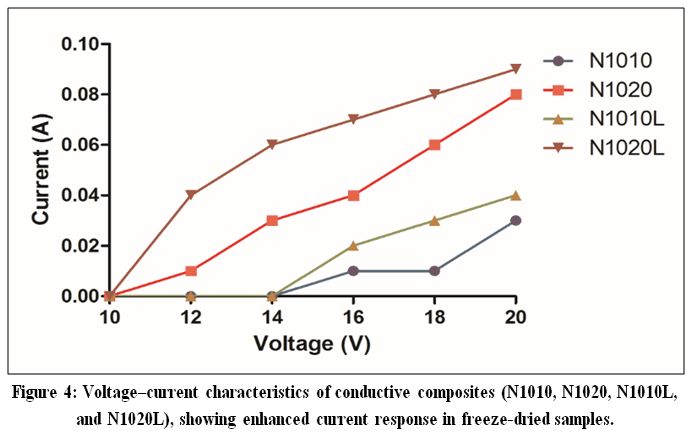 |
Figure 4: Voltage–current characteristics of conductive composites (N1010, N1020, N1010L, and N1020L), showing enhanced current response in freeze-dried samples. |
Discussion
The present work demonstrates that the intrinsic hierarchical architecture of natural feathers can be effectively utilized as a three-dimensional scaffold for conductive composites.Surface functionalization of natural feathers is required due to their insulating nature. Polydopamine coating enhances interfacial adhesion and enables uniform anchoring of carbon nanotubes. Since CNTs are highly aggolomeratednanoforms so their modifications improves dispersion and so facilitates stable conductive network formation.
Processing methodology plays a critical role in determining composite performance where freeze-dried samples exhibited improved conductivity and network continuity compared to normal dip coated air dried samples. This occurs as freeze drying process allow direct sublimation process where ice the solid state converts directly to gaseous form and hence allow better preservation of the three-dimensional structure. The electrical behavior follows a percolation trend, with optimal conductivity observed at intermediate CNT loadings, while excessive loading leads to aggregation and limited improvement. The composites exhibited stable electromechanical performance under bending, stretching, and repeated reformation steps, indicating robust structural integrity. Overall, the results highlight that structural preservation, interfacial engineering, and processing strategy are key factors in designing sustainable bio-based conductive composites. Further enhancements may be achieved through controlled filler alignment and hybrid conductive systems.
Conclusion
The prepared composite showed conducting nature in the skeleton of non-conduction natural feather. The usage of natural feathers not only provide a base for connecting network but also help to utilize natural biodegradable resources rather than using synthetic polymers tending towards sustainability. The method of modification of CNTs also played role in conduction aspect. The greener process of non -covalently modified CNTs proved to be an efficient method to attain conducting networks. This work also defined the advantage of process of freeze drying in preparing compact densely connected networks for formation of flexible conducting sustainable composites.
Acknowledgement
Authors are thankful to Director, DIPAS for allowing to do the research activity. We are thankful to entire HIS & WPG division of DIPAS, DRDO for providing different lab instruments. First author Ayushi is thankful to DRDO fellowship.
Funding Sources
The authors sincerely acknowledge theDIPAS-Buildup-2025 funds for supporting this research work.
Conflict of Interest
The authors do not have any conflict of interest.
Data Availability Statement
The manuscript incorporates all datasets produced or examined throughout this research study.
Ethics Statement
This research doesn’t involve human participants, animal subjects, or any material that require ethical approval.
Author Contributions
- Ayushi Singh: Data collection, manuscript writing.
- Neha Agrawal: Supervision, conceptualization, review & editing, finalization, validation, analysis.
- Savita Gaur: Reviewing.
References
- Liu Y, He K, Chen G, Leow WR, Chen X. Nature-Inspired Structural Materials for Flexible Electronic Devices. Chemical Reviews. 2017;117(20):12893-12941. doi:10.1021/ACS.CHEMREV.7B00291
CrossRef - Rogers JA, Someya T, Huang Y. Materials and mechanics for stretchable electronics. Science. 2010;327(5973). doi:10.1126/science.1182383
CrossRef - Lu J, Ming X, Cao M, et al. Scalable Compliant Graphene Fiber-Based Thermal Interface Material with Metal-Level Thermal Conductivity via Dual-Field Synergistic Alignment Engineering. ACS Nano. 2024;18(28):18560-18571. doi:10.1021/acsnano.4c04349
CrossRef - Lu XH, Liu J, Shu C, et al. Densifying Conduction Networks of Vertically Aligned Carbon Fiber Arrays with Secondary Graphene Networks for Highly Thermally Conductive Polymer Composites. Advanced Functional Materials. 2025;35(11):2417324. doi:10.1002/adfm.202417324
CrossRef - Li L, Zhu C, Wu Y, Wang J, Zhang T, Liu Y. A conductive ternary network of a highly stretchable AgNWs/AgNPs conductor based on a polydopamine-modified polyurethane sponge. RSC Advances. 2015;5(77). doi:10.1039/c5ra10961b
CrossRef - Yu Y, Zeng J, Chen C, et al. Three-dimensional compressible and stretchable conductive composites. Advanced Materials. 2014;26(5). doi:10.1002/adma.201303662
CrossRef - Li C, Zhang L, Wang L, Ren M, Jiang A. Research Status of Carbon Fiber and Its Hybrid Composites. Polymer Composites. Published online 2025. doi:10.1002/PC.70746;REQUESTEDJOURNAL:JOURNAL:15480569;WGROUP:STRING:PUBLICATION
CrossRef - Chen R, Tang H, Dai Y, et al. Robust Bioinspired MXene-Hemicellulose Composite Films with Excellent Electrical Conductivity for Multifunctional Electrode Applications. ACS Nano. 2022;16(11). doi:10.1021/acsnano.2c08163
CrossRef - Zhang Q, Wang K, Chen X, Tang X, Zhao Q, Fu Q. Biomass composite based on metallized bamboo fiber for electromagnetic interference shielding, joule heating, and solar heating. Composites Science and Technology. 2023;243. doi:10.1016/j.compscitech.2023.110228
CrossRef - Kamarudin SH, Mohd Basri MS, Rayung M, et al. A Review on Natural Fiber Reinforced Polymer Composites (NFRPC) for Sustainable Industrial Applications. Polymers. 2022;14(17):3698. doi:10.3390/POLYM14173698
CrossRef - Sun W, Fang Y, Wu L, Liu X. Micron down feather fibers reinforced cellulose composite aerogel with excellent acoustic and thermal insulation. Journal of Porous Materials. 2023;30(3). doi:10.1007/s10934-022-01403-1
CrossRef - Qiang YX, Zhu CH, Liu Y, Cui S. Fabrication of highly conductive silver nanowires flexible conductor based on polydopamine-modified goose down network. Journal of Materials Science: Materials in Electronics. 2018;29(8). doi:10.1007/s10854-018-8618-y
CrossRef - Wu Q, Li W, Liu C, et al. Carbon fiber reinforced elastomeric thermal interface materials for spacecraft. Carbon. 2022;187. doi:10.1016/j.carbon.2021.11.039
CrossRef
 PlumX:
 Views: 1451 Views
  PDF Downloads:
269
PDF Downloads:
269 Accepted on: 28 Apr 2026
Second Review by: Dr. Nitin Pawar
Final Approval by: Dr. Oscar Jaime Restrepo Baena