
FT-IR Spectroscopic and XRD Studies on Tris-Thiourea Strontium Chloride Single Crystals
1Department of Physics, M. M. Science College, Morbi - 363 642, India.
2Forensic Science Laboratory, Gandhinagar, India.
DOI : http://dx.doi.org/10.13005/msri/080129
Download this article as:

There are various nonlinear optical materials having crystalline nature and find various applications in science and technology. Tris-thiourea strontium chloride was synthesized and single crystals were grown by the slow solvent evaporation technique using aqueous solvent. The grown crystals were characterized by Fourier Transform Infrared Spectroscopy (FT-IR), and X-ray diffraction analysis (XRD). The FT-IR spectra of these crystals were recorded in the wave number range 400-4000 cm-1 which reveals the presence of various functional groups. The powder XRD analysis suggested orthorhombic crystal structure.
KEYWORDS:Tris-thiourea strontium chloride; FT-IR; XRD
Introduction
Nonlinear Optical (NLO) materials crystals are of considerable interest and of great demand because of their different applications in science and technology, such as different harmonic generators, sum and different generators and parametric oscillators.1-2
The inorganic and organic class of NLO materials is also available with different merits and demerits.3-4 The semi-organic class of NLO materials possesses both the properties of organic and inorganic NLO materials.5-7 Metal complexes of urea and urea analogs have been explored.7 Bis-thiourea cadmium chloride8 and bis-thiourea zinc chloride9 crystals have been synthesized, grown and characterized, which exhibit good NLO properties. Compared to other similar crystals, bis-thiourea cadmium chloride exhibit more laser induced damage threshold values.10
Recently, tertrakis thiourea nickel chloride,11 bis-thiourea bismuth chloride12 and zinc tris thiourea sulphate13 crystals are reported which are urea based semi-organic NLO crystals. In the present study we have synthesized tris-thiourea strontium chloride (TTSC) crystals by slow solvent evaporation method. The grown crystals were characterized by FT-IR and powder XRD.
Experimental
The slow solvent evaporation method was used to synthesize TTSC crystals. AR grade thiourea and strontium chloride was used in double distilled water. The expected chemical reaction was

The synthesized salt was purified by several time re-crystallizations. TTSC single crystals were grown by slow evaporation technique at room temperature. The growth vessel was closed and through a small opening slow evaporation was allowed.
A constant temperature water bath with ± 0.1oC accuracy was used to maintain the constant temperature. Crystal growth was completed in about 10 days. In the present investigation, the growth of TTSC single crystals by slow evaporation technique at room temperature and its characterization by using FT-IR and powder XRD are reported.
Results and Discussion
FT-IR Study
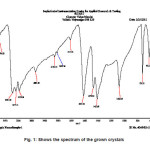
The FT-IR spectrum of bis-thiourea zinc chloride14 and zinc tris thiourea sulphate15 have been reported. The FT-IR spectrum of the grown crystals was recorded in the wave number range 4000-400 cm-1. Fig. 1 shows the spectrum of the grown crystals.
The C – S stretching vibrations occur at 3277 cm-1, while the C – S bending occurs at 1083 cm-1. The N – H primary stretching vibrations occur at 3381 cm-1 and 3178 cm-1, while the NH2 stretching vibrations occur at 1472 cm-1. The vibrations occurring below 900 cm-1 may be due to metal and halogen bonding vibrations.
Figure 1: Shows the spectrum of the grown crystals
 Click on image to enlarge |
Powder XRD Study
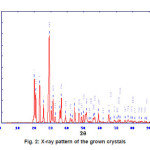
The grown crystals have been characterized by powder X-ray diffractometer. Fig. 2 represents the powder X-ray pattern of the grown crystals.
Using powder X computer software the h, k and l parameters as well as d and 2θ values were generated in such a way that these values match with the powder X-ray diffraction pattern. The estimated values of unit cell parameters of TTSC crystals are a = 9.850 Ao, b = 9.700 Ao, c = 18.000 Ao and α = β = γ = 90o, which shows orthorhombic crystal structure. Earlier workers reported the powder XRD study and estimated the unit cell parameters of bis-thiourea zinc chloride.14 Orthorhombic form of BTCA was also reported earlier.16
Figure 2: X-ray pattern of the grown crystals
 Click on image to enlarge |
Conclusion
TTSC crystals were grown by slow solvent evaporation technique. The grown crystals were characterized by FT-IR spectroscopic and XRD. The FT-IR spectrum of the grown crystals revealed the presence of C – S and N – H bond. From the XRD study of the grown crystal, the estimated values of unit cell parameters of TTSC crystals were found to be a = 9.850 Ao, b = 9.700 Ao, c = 18.000 Ao and α= β = γ = 90o, which confirmed the orthorhombic crystal structure.
References
- V. G. Dimitriev, G. G. Gurzadyan and D. N. Nikigosyan, Handbook of Nonlinear Optical Crystals (Springer Series in Optocal Science, 64 (1991).
- Eimerl D., Velsko S., Davis L. and Wang F. Crystal Growth and Characterization of Materials, ed J. B. Mullin 20: 59.
- X. Wang, J. Zhang, D. Xu, M. Lu, D. Yuan, S. Xu, J. Huang, G. Zhang, S. Guo, S. Wang, X. Duan, Q. Ren and G. Lu, J. Crystal Growth, 235(2002) 340.
CrossRef - D. Chemla and J. Zyss, Nonlinear Optical Properties of Organic Molecules and Crystals, (Academic Press, Orlando, Vol. 1- 2( (1987).
- D. Xu, M. Jiang and Z. Tn, Acta Chem. Sinica,41: 570 (1983).
- A. Petrosyan, R. Sukiasyan, H. Karapetyan, S. Terzyan and R. Feigelson, J. Crystal Growth, 213: 103 (2000).
CrossRef - P. R. Newman, L. F. Warren, P. Cunningham,T.Y. Chang, D. E. Copper, G. L. Burdge, Polak Dingels and C. K. Lowe-Ma, Semi-organics, a new class of NLO Materials in Advances in Organic Solid State Materials – Materials Research Society Symposium Proceedings– ed. C. Y. Chiang, P. M. Chaikan and D. O. Cowan, 173: 557 (1990).
- S. Selvakumar, J. Packiam Julius, S. Rajasekar, A. Ramanand and P. Sagayaraj,Mater. Chem. Phys., 89: 243 (2004).
- P. Angelin Mary and S. Dhanuskodi, Cryst. Res. Technol, 36: 1231 (2001).
CrossRef - G. Xing, M. Jiang, Z. Sao and D. Xu, Chin. J. lasers, 14: 302 (1987).
- A. Bhaskaran, C. Raghavan, R. Sankar, R. Mohan Kumar and R. Jayavel, Cryst. Res. & Technol., 42: 477 (2007).
CrossRef - R. Sankar, C. Raghavan and R. Jayavel, Crystal Growth & Design 7: 501 (2007).
CrossRef - C. Krishnan, P. Selvarajan, T. Freeda, Materials & Manufacturing Processes, 23: 800 (2008).
CrossRef - A. Anuradha, Ph. D. Thesis, Madras Universitry, Madras (2007).
- A. Coats and J. Redfern, Nature, 201: 68 (1964).
- CrossRef
- R. Sankar, C. Raghavan and R. Jayavel,Cryst. Res. & Technol., 419: 919 (2006).
CrossRef
 PlumX:
 Views: 236 Views
  PDF Downloads:
878
PDF Downloads:
878 Accepted on: 08 May 2011